Population
1.4BHow They Pay in China
1976–2026. Fifty years of cash, cards, and the apps that changed everyday life.

GDP
$19.5TGDP per Capita
$14KGDP Growth
5.0%The country behind the checkout
A continental economy.
A payment revolution.
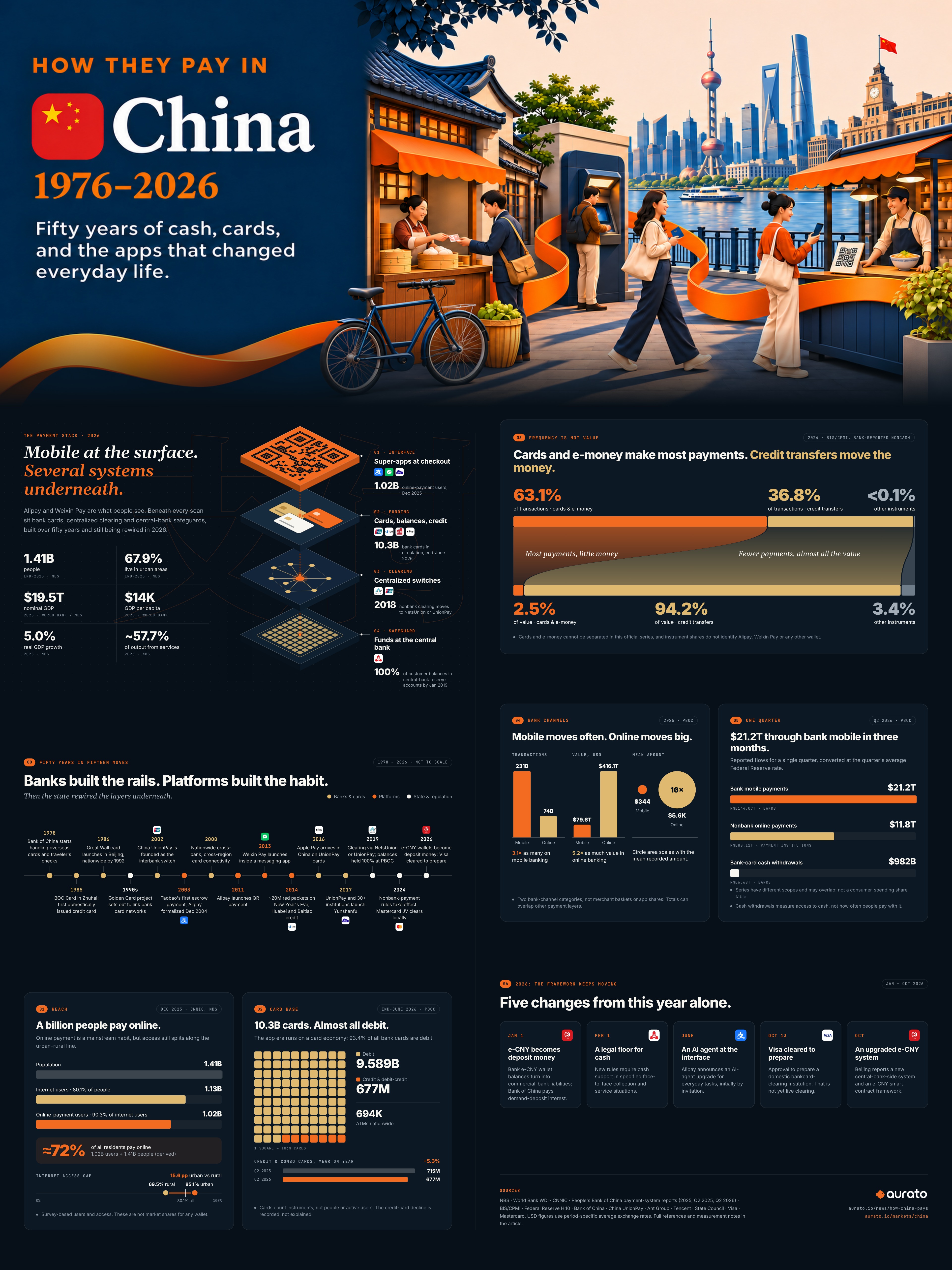
 China's payments story operates at continental scale. This deep dive traces how the country has paid over the past fifty years and maps its payments landscape in 2026. Mainland China ended 2025 with 1.4 billion people, of whom 67.9% lived in urban areas. Its economy generated $19.5T in GDP that year, with real growth of 5.0%. Services contributed approximately 57.7% of output, alongside a substantial industrial economy. Paying in China means serving a vast population across cities, smaller towns, and rural communities, and an economy that combines manufacturing, commerce, and everyday services. 343537
The financial infrastructure is equally large. At the end of June 2026, China reported 10.3 billion bank cards and 694 thousand ATMs. Those foundations sit beneath a consumer landscape in which apps such as  Alipay and
 Weixin Pay connect payments with shopping and daily services. Cash and physical cards continue to have a place alongside the phone. 142022
The chapters that follow connect cash and economic reform with the first domestic cards and national banking networks, the rise of Alipay and Weixin Pay, and the spread of QR acceptance. They end with the roles of cash, cards, wallets, and the  digital renminbi in 2026, examining the commercial needs and institutional choices that shaped each stage.
China at a glance
| Population | 1.41B at end-2025. 35 |
|---|---|
| Urban population | 67.9% at end-2025. 35 |
| Annual GDP | $19.5T, nominal, in 2025. 34 |
| Real GDP growth | 5.0% in 2025. 34 |
| Bank cards | 10.3B at end-June 2026. 20 |
| ATMs | 694K at end-June 2026. 20 |
Population and GDP use the latest complete calendar year; payment infrastructure uses the Q2 2026 release. Cards are not unique holders, and ATM counts do not measure cash-purchase frequency.
011976 onward
Before the smartphone: cash in a changing economy
Our story begins in 1976, before China's reform era. Households paid in cash, while payments between enterprises largely moved through entries in bank accounts. The economic reforms beginning in 1978 expanded commerce and gradually increased the demands on both systems. For an everyday purchase, physical money let value change hands without a terminal, a network connection, or a shared financial provider. 2
The historical picture contains a useful complication. An IMF study published in the mid-1990s described an economy still heavily dependent on cash and reported that cash transactions had expanded during the reform period. Household consumption and the growth of township and village enterprises contributed to that increase. Modernization did not immediately mean less physical money. More market activity could initially mean more occasions to use it. 2
Business settlement was a different story. The same study distinguished cash use from the bookkeeping transfers used between enterprises. This matters when interpreting any historical claim about a "cash economy": the way households paid at shops was not necessarily the way firms settled large obligations. 2
International contact also began to reshape the system.  Bank of China dates its handling of overseas-issued credit cards and foreign travelers' checks to 1978. Those services supported a developing connection with foreign visitors and financial institutions; they were not evidence that domestic households already had a mass card-payment habit. 3
The emerging challenge was geographical and institutional. As commerce expanded, money needed to become easier to access and transfer across branches, banks, and cities. A cash payment could be completed locally. An account-based payment required organizations to coordinate beyond the counter.

021985–2008
Cards arrived before the wallet revolution
In March 1985, Bank of China's Zhuhai branch launched the Bank of China Card, which the bank identifies as mainland China's first domestically issued credit card. Its initial use was local and issuance was limited. The early product was a beginning, rather than a fully formed national network. 4
The Great Wall card followed. Bank of China records a Beijing launch in June 1986 and a decision that October to issue its  renminbi Great Wall credit card nationally. Expansion took time: the bank identifies issuance in Lhasa in September 1992 as the milestone that completed nationwide geographic coverage. A launch date and a national rollout date describe different achievements. 56
During the 1990s, the Golden Card project pursued a broader ambition: connecting the banking industry's separate card networks. Issuing plastic was only one part of the task. A card becomes much more useful when a customer can use another bank's acceptance infrastructure and transact beyond the place where the account was opened. 7
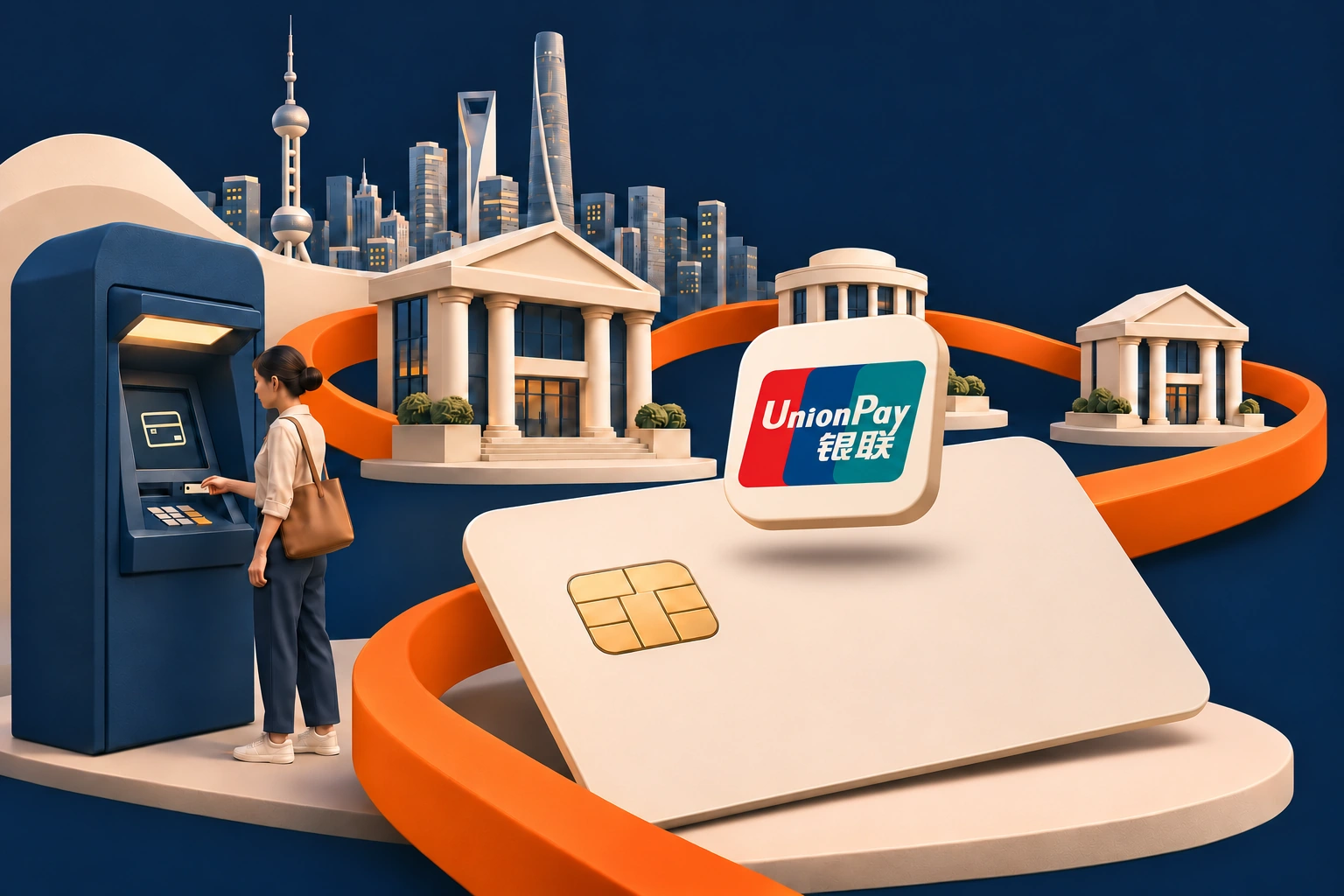
 China UnionPay's establishment in March 2002 was a decisive institutional step. Its role included building a national interbank card-information exchange platform and common standards.
 UnionPay's history describes broad connectivity among major cities by early 2003 and nationwide cross-region, cross-bank connectivity by 2008. 8
That achievement should sit near the center of any account of Chinese payments. The later visibility of wallets can obscure the earlier work of making accounts accessible and institutions interoperable. Banks, ATMs, cards, acquiring relationships, and clearing arrangements created capabilities on which further services could build.
Cards also continued to evolve. Bank of China's history records international-network membership in 1987, subsequent international card issuance, and later chip and digital-card products. These were successive changes in reach and functionality, rather than one fixed technology waiting to be displaced. 9
032003 onward
Alipay solved an online trust problem
The next turning point began with a question familiar to anyone buying from an unknown seller: who should take the first risk?
A buyer did not want to send money and receive nothing. A seller did not want to ship without confidence of payment. Alipay's early escrow arrangement placed an intermediary between those risks: funds could be held until the buyer received the goods and confirmed satisfaction, then released to the seller. A World Bank and  PBOC study identifies this trust mechanism as a foundation of its early appeal. 10
 Ant Group's corporate history distinguishes the first guaranteed transaction service on Taobao in October 2003 from Alipay's formal establishment in December 2004. That distinction helps reconcile the two dates often attached to its origins. The product began as a solution within commerce before becoming a much wider consumer platform. 11
Its later development broadened the relationship. Ant's 2020 prospectus records the Alipay mobile app in 2009, Quick Pay in 2010, QR payment in 2011, Yu'ebao in 2013, and  Huabei in 2014. Payments, money management, and credit increasingly appeared within the same digital environment. Those are different financial services, even when a consumer encounters them through one app. 12
The strategic lesson is about distribution. A payment product attached to a marketplace starts with a reason for people to transact. It can improve a purchase that already has a buyer, a seller, and an intended outcome. Once users trust that experience, the provider has an opportunity to serve further needs.
That does not mean every later Alipay payment uses escrow. The early trust mechanism explains an origin; it should not be mistaken for a universal description of today's transactions.

042013 onward
Weixin Pay made money social
 Tencent approached payments through a different relationship. People were already using its services to communicate. Adding money movement could extend that relationship from messages to shared activities and everyday obligations.
Tencent dates Weixin Pay's launch to August 2013. Its product description explains the connection with Tenpay and the ability to link bank cards. The consumer experience moved into a communication app, while banking relationships remained part of the underlying arrangement. 1314
In January 2014, Tencent introduced Weixin Red Packet. The digital feature adapted the familiar practice of giving monetary gifts in red envelopes to a social network. Tencent records nearly twenty million red packets exchanged on that year's Chinese New Year's Eve. The figure describes exchanges during a specific occasion, not unique users or ordinary merchant purchases. 13
Its importance went beyond a festive campaign. A social interaction gave people a reason to try moving money digitally. The same broad environment could then support paying someone back, sending a gift, or purchasing a service. The World Bank's analysis highlights the advantage of adding payment functionality to platforms that already had large user networks. 10
Weixin's Mini Programs, launched in 2017, extended the platform further. Services could sit inside the app experience instead of requiring a separate download for every merchant or task. 13
Alipay's commerce roots and Weixin Pay's social roots help explain their different paths into daily life. Their subsequent expansion brought them into many overlapping situations, but their origins reveal why adoption was about more than presenting a better payment button.

05The acceptance shift
Why QR codes changed the economics of acceptance
The QR code's contribution was practical. A merchant could display a code for the customer to scan, or scan a code presented by the customer. Static printouts and more capable dynamic devices supported different operating models. IFC's merchant-payments handbook describes these approaches and their distinct checkout steps. 15
For a small retailer, avoiding a conventional terminal could lower the initial barrier to accepting electronic payments. The attraction also depended on customer demand, onboarding, confirmation, and the provider's broader commercial offer. A low-cost sign alone could not supply those services. 16
This distinction helps explain why a technical format became economically consequential. The phone could perform part of the work previously assigned to specialized equipment. Existing platform relationships could help with distribution. Merchant acceptance and consumer use could reinforce each other.
There were benefits beyond the individual sale. Research published by the BIS, using data from around half a million Chinese firms, found that a QR-payment footprint could help firms access credit from the platform and could support access to bank credit. The study also found positive effects on sales from access to big-tech credit. Those findings concern the studied businesses and lending relationships; they do not establish that every merchant gains the same benefit. 17
A useful interpretation is that payment acceptance also became a way to create a financial record. For a small business, a stream of observable transactions can communicate something that an informal cash history cannot easily demonstrate to a lender.
The same process raises questions about who controls the record and how it can be used. Payments can improve access while increasing dependence on the company that organizes the customer relationship. That tension sits at the heart of the platform model. 18
062017–2026
Banks and regulators remained inside the story
UnionPay and the banks developed their own mobile response. In December 2017, UnionPay and more than thirty commercial banks and payment institutions launched the unified  Mobile QuickPass app, known in China as Yunshanfu. The launch brought together linked cards, account management, QR payments, and other mobile services. Card infrastructure and mobile interfaces were converging. 19
Other brands illustrate how varied that convergence became.  Apple Pay expanded to China in February 2016 with support for UnionPay debit and credit cards. A phone-based checkout could therefore be a new interface for a card, rather than a separate payment-account ecosystem. 32
JD developed a commerce-centered offer too. Its payment platform,  JD Pay, describes linked-card payments alongside
 Baitiao, the consumer-credit product it dates to February 2014, and other funding options. This points to another distinction: a retailer's payment brand can organize several ways to fund a purchase. A credit product, a wallet, and a contactless interface need not be competing descriptions of the same thing. 33
The regulatory architecture changed too. From 2018, nonbank payment clearing moved toward centralized arrangements through  NetsUnion or UnionPay. By January 2019, payment institutions were required to hold customer payment-account balances fully in central-bank reserve accounts. The BIS describes these changes as a way to improve transparency and protect customer funds. 18
A wallet therefore needs to be understood in layers. The app presents the payment experience. Its funding can involve a linked card or a payment-account balance. Clearing and settlement involve further institutions and rules. A recognizable logo at checkout does not identify every organization involved in moving the money.
The State Council's nonbank-payment regulations, effective May 2024, further formalized oversight of licensed payment institutions, user protection, and risk management. The regulatory direction was to bring a mature industry into a more explicit framework. 21
These changes make a purely technological explanation inadequate. A payment method has to work commercially and institutionally as well as technically. Consumer convenience can attract use; the handling of funds, risk, and disputes determines whether that convenience can operate at scale.
07State of the union · 2026
The landscape in 2026: mobile at the surface, several systems underneath
The clearest current picture is a layered one. Alipay and Weixin Pay provide familiar everyday interfaces; UnionPay, bank apps, physical cards, cash, and the digital renminbi serve additional roles. The categories overlap because they describe different parts of a payment. 14192025
The PBOC's second-quarter 2026 figures put the card base at 10.267 billion, including 9.589 billion debit cards and 677 million credit and debit-credit combination cards. About 93.4% were debit cards, using the reported rounded totals. These are cards, not people or active users. 20
For the quarter, banks reported approximately $21.2T in mobile payments; nonbank payment institutions reported approximately $11.8T in online payments. Bank-card cash withdrawals totaled approximately $982B. These dollar equivalents convert the PBOC's original RMB144.07 trillion, RMB80.11 trillion, and RMB6.68 trillion using the quarter's average Federal Reserve exchange rate. The series have different scopes and may overlap. They are not a consumer-spending market-share table. 2036
Reading the payment engine
Reach and access are one part of the picture. At December 2025, CNNIC estimated 1.02 billion online-payment users, equivalent to 90.3% of internet users. Internet penetration was 80.1% overall, 85.1% in urban areas, and 69.5% in rural areas: a 15.6 percentage-point gap. These survey-based adoption figures describe users and access, rather than the market shares of individual wallets. 40
Frequency and value tell different stories. In 2025, the PBOC reported approximately 231 billion mobile-banking transactions worth $79.6T, compared with 74 billion online-banking transactions worth $416.1T. Mobile banking handled about 3.1 times as many transactions, while online banking carried about 5.2 times as much value. Mean recorded amounts were approximately $344 and $5.6K, respectively. These are two bank-channel categories, rather than a comparison of merchant baskets or app market shares; their totals can overlap other payment layers. 3839
The China market record's 2024 bank-reported noncash instrument data reveal another contrast. Cards and e-money together represented 63.1% of reported transactions but 2.5% of value; credit transfers represented 36.8% of transactions and 94.2% of value. The totals include large transfers as well as smaller payments. Cards and e-money cannot be separated in this official series, and these instrument shares do not identify the shares of Alipay, Weixin Pay, or any other wallet. The overview beside Sources & Notes brings these layers together, with their reference periods and definitions kept visible. 4142

For comparison, the PBOC's Q2 2025 report counted 715 million credit and debit-credit combination cards. The lower 2026 figure indicates that this card category was contracting over that interval. It does not, by itself, establish why cards were closed or how each former holder subsequently paid. 120
The practical task for someone assessing the market is to identify which layer a number describes. App accounts, payment users, cards, transactions, and processed value answer different questions. None can stand in for all the others.
08Access & inclusion
Cash and international access reveal the gaps
China's policy response makes clear that widespread mobile use does not remove the need for payment choice. The State Council's 2024 payment-convenience program called for improvements across cash, cards, mobile payments, and account services, with particular attention to older people and overseas visitors. 22
The visitor experience illustrates a limitation of a successful domestic ecosystem. A method can feel effortless once a person has the right account and credentials, while presenting more friction to someone arriving from abroad. Improving foreign-card acceptance and access to local wallets addresses that boundary rather than simply adding another checkout feature. 22
New cash-receipt and service rules took effect on February 1, 2026. They require cash support for specified face-to-face collection and service situations, make provisions for self-service environments, and address banks' cash-service responsibilities. The rules also distinguish transactions completed entirely online. 23
The implication is substantial: a highly digital market still needs functioning alternatives. A payment system's reach includes the people who cannot or prefer not to follow its most common digital path. It also includes the circumstances in which a device or connection fails.
International card competition is evolving as well.  Mastercard's Chinese bankcard-clearing joint venture began official domestic operations in May 2024.
 Visa announced approval to prepare a domestic bankcard-clearing institution on October 13, 2026. Visa's preparation approval should be distinguished from permission to commence live domestic clearing. 2426
09A changing framework
The digital renminbi changed in 2026
The digital renminbi, or e-CNY, deserves its own treatment. It has a different institutional purpose from a private wallet, and its design has continued to evolve.
PBOC deputy governor Lu Lei's account of the program dates research and closed testing to 2014. His December 2025 explanation set out a new framework beginning January 1, 2026: commercial-bank e-CNY wallets would move into a deposit-money arrangement, with the balances treated as commercial-bank liabilities under central-bank management and technical support. 25
The practical change was visible in bank notices. Bank of China announced that balances in its verified-identity e-CNY wallets would earn interest at its posted demand-deposit rate from January 2026.  China Construction Bank issued a corresponding notice, specifying the applicable wallet scope and excluding category-four wallets from the interest provision. 2728
In October 2026, the Beijing financial authority reported the release of an upgraded central-bank-side digital-renminbi system and an e-CNY smart-contract service framework. Its description emphasized integration with the banking system and applications spanning retail and wholesale activity. 29
That makes an older, static description of e-CNY incomplete. Any account of its present role needs to distinguish the original digital-cash model from the deposit-based framework now being implemented.
For adoption, the commercial question remains demanding. A new monetary arrangement must offer a useful reason for a person, business, or institution to change a familiar process. Better execution of a conditional payment or a business obligation may matter more than replicating an already convenient retail checkout. This is Aurato's interpretation of the opportunity, rather than a forecast of a particular market share.
10The next chapter
The next chapter is about the activity around the payment
Innovation is continuing at the interface. Alipay introduced Tap! in June 2024; its April 2025 announcement described an experience in which users tap an unlocked phone at a compatible terminal or tag instead of opening the app and scanning manually. A market associated with QR payments is still changing the action required at checkout. 30
In June 2026, Alipay announced an AI-agent upgrade for finding services and executing everyday tasks through conversation, with access initially by invitation and a gradual rollout planned. The announcement demonstrates a product direction, rather than proof that all users had adopted that experience. 31
Across these developments, the recurring opportunity is to make the surrounding activity easier: completing an order, finding a service, managing a merchant relationship, or fulfilling an obligation. Payment is valuable because it lets something else happen.
For Aurato, three questions will help track the next phase: whether access becomes easier across different providers and user groups; whether new interfaces reduce meaningful friction; and whether improved infrastructure produces recurring use beyond a launch campaign.
China's past fifty years offer a strong reason to watch those questions. The landscape has repeatedly changed when a payment innovation met a wider commercial or social need. The next decisive development will have to earn its place in daily life in the same way.
The evidence behind the story
Sources
- 1.PBOC, Payment System Report (Q2 2025).
- 2.IMF, Monetary and Exchange System Reforms in China: An Experiment in Gradualism, chapter VI, "Payments, Clearing, and Settlement System" (1996).
- 3.Bank of China, history of credit-card services beginning in 1978.
- 4.Bank of China, "China's First Credit Card."
- 5.Bank of China, "China's First Great Wall Card."
- 6.Bank of China, "China's First Credit Card Issued Nationwide."
- 7.USTR, submission in WTO dispute DS413, discussion of the Golden Card project (2011).
- 8.China UnionPay, corporate development history (2021).
- 9.Bank of China, "The 30th Anniversary of BOC Credit Card" (2016).
- 10.World Bank and PBOC, Toward Universal Financial Inclusion in China (2018), section 4.3.1.
- 11.Ant Group, corporate milestones: October 2003 and December 2004.
- 12.Ant Group, 2020 prospectus, "History and Development," pp. 135-136. The proposed IPO did not complete; the document is used for historical product milestones.
- 13.Tencent, "Our story," milestones for 2013, 2014, and 2017.
- 14.Tencent, "Weixin Pay."
- 15.IFC, Merchant Payments and Digital Financial Services Handbook (2020), QR-code products section.
- 16.World Bank, Electronic Payments Acceptance Incentives: Literature Review and Country Examples (2022), China case study.
- 17.Beck et al., "Big techs, QR code payments and financial inclusion," BIS Working Paper 1011 (2022).
- 18.BIS, "Big tech in finance: opportunities and risks," Annual Economic Report (2019), including Box III.C.
- 19.UnionPay International, unified Mobile QuickPass app launch (December 2017).
- 20.PBOC, Q2 2026 payment-system figures, reproduced by Cebnet with images of the original report (September 4, 2026).
- 21.State Council, Regulations on the Supervision and Administration of Nonbank Payment Institutions, effective May 1, 2024.
- 22.State Council General Office, payment-convenience program (March 2024), reproduced by the Ministry of Ecology and Environment.
- 23.PBOC, NDRC, and NFRA, Provisions on Renminbi Cash Receipt, Payment and Services, effective February 1, 2026; full text reproduced by the Beijing Consumers Association.
- 24.Mastercard NetsUnion, corporate history and commencement of operations.
- 25.Lu Lei, "Uphold fundamental principles and innovate to steadily develop the digital renminbi" (December 31, 2025), reproduced by the Jiangsu Payment and Clearing Service Association.
- 26.Visa, preparation approval for a domestic bankcard-clearing institution (October 13, 2026).
- 27.Bank of China, e-CNY interest notice (December 31, 2025).
- 28.China Construction Bank, e-CNY interest and service-agreement notice (December 31, 2025).
- 29.Beijing Municipal Bureau of Local Financial Regulation, 2026 digital-renminbi annual meeting and infrastructure release (October 21, 2026).
- 30.Ant Group, Alipay Tap! announcement (April 2025), including its June 2024 introduction.
- 31.Ant Group, Alipay AI-agent upgrade announcement (June 16, 2026).
- 32.Apple, "Apple Pay Has Expanded to China" (February 2016).
- 33.JD Pay, product overview, including Baitiao's February 2014 launch.
- 34.National Bureau of Statistics of China, preliminary GDP accounting for 2025 (January 21, 2026). Services share calculated as tertiary-industry value added divided by total GDP. Nominal GDP is displayed in US dollars using the World Bank series cited in [37].
- 35.National Bureau of Statistics of China, 2025 national economy release (January 19, 2026), population and urbanization. Population covers the mainland statistical scope and is rounded in the introduction to one decimal place in billions.
- 36.Federal Reserve, H.10 daily historical Chinese-renminbi rates. Q2 2026 mean: 63 published observations, RMB6.804787301587302 per US dollar; used only to express the PBOC's quarterly RMB totals as approximate USD equivalents.
- 37.World Bank, World Development Indicators, GDP in current US dollars (NY.GDP.MKTP.CD), China, 2025. The $19.5T figure uses the same series and compact presentation as the Aurato China market record.
- 38.People's Bank of China, Payment System Statistics 2025, bank electronic channels and bank-card activity. Counts and original renminbi values checked in the full-year report; the PBOC Clearing Center also links this original PDF.
- 39.Federal Reserve, G.5A annual foreign-exchange release, January 5, 2026. The China/Yuan row gives calendar-year means of RMB7.1875 per US dollar for 2025 and RMB7.1957 for 2024. Annual dollar figures in the data atlas use these period-specific conversions.
- 40.CNNIC, The 57th Statistical Report on China's Internet Development, December 2025 observations. Printed pages 14, 23 and 27 cover urban/rural internet penetration, the application-user table and online payments. Online-payment users are rounded from 1,016,550,000 to 1.02 billion; the 90.3% denominator is internet users, not the entire population.
- 41.BIS/CPMI, cashless payment statistics for China, calendar 2024, dataflow WS_CPMI_CASHLESS. Five reported instrument categories and their count/value observations were checked against the official SDMX API. Cards/e-money issued inside the country are inseparable. Shares are calculated from the sum of the five reported categories; cash, separately reported nonbank network channels and system-processing totals are excluded.
- 42.Aurato China market record, retrieved November 11, 2026. The data atlas uses its World Bank 2025 country scale and the published BIS/PBOC 2024 instrument profile, independently cross-checked against the original observations. Published compact dollar formatting is retained.