Begin with what the code is supposed to identify
A payment file can contain several short codes that appear equally precise. One refers to the issuing institution behind a card range, another to a bank office, and another to the activity of the accepting merchant. Looking up the right value in the wrong directory can produce an answer that sounds plausible while addressing a completely different question.
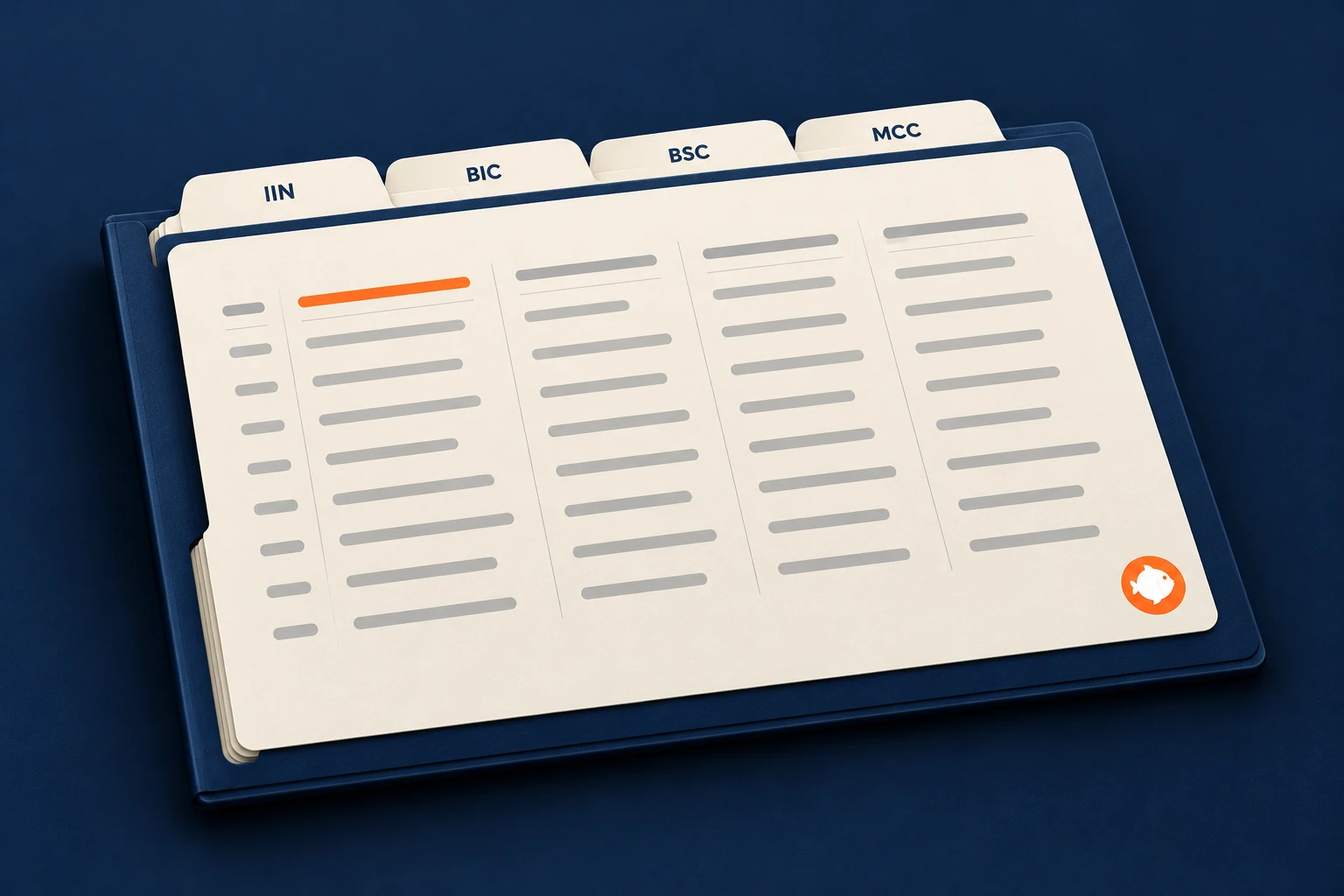
Identifiers is the entry point for four lookup families in Atlas. Open Identifiers from the Atlas navigation, then choose IIN/BIN, BIC, BSC or MCC. Each page combines a search with a guide to the code’s structure and interpretation. The aim is to connect a compact identifier with understandable payment context, including the institution, market or category it represents.
Four families, four different questions
Use IIN/BIN for the issuer and characteristics associated with the leading digits of a payment card number. Use BIC for the registered business party, location or branch addressed in financial messaging. Use BSC for an institution, office or clearing endpoint inside a domestic code system. Use MCC for the category attached to an accepting merchant activity.
These are separate reference systems. A BIC is not a customer’s account number, and a domestic routing code is not an international replacement for it. An MCC can be shared by thousands of merchants and is not their merchant ID. Keeping the family explicit in a spreadsheet or report prevents a useful code from losing its meaning as it moves between teams.
| Family | Input | What it describes |
|---|---|---|
| IIN / BIN | First 6–11 card-number digits only | The published card prefix or range and available issuer/product attributes. |
| BIC | 8- or 11-character code, or a legal entity name | A business party or branch used in financial messaging. |
| BSC | A domestic code plus its system where known | A bank, branch or clearing endpoint in a national directory. |
| MCC | Four digits, preserved as text | A merchant activity category, qualified by scheme and version. |
IIN/BIN: resolve the card prefix
On IIN/BIN Lookup, enter only the first six to eleven digits and choose Search, or use one of the example prefixes on the page. Never enter a full card number, expiry date or security code. IIN is the formal Issuer Identification Number; BIN, or Bank Identification Number, is the familiar industry term. Aurato uses both labels so the lookup is easy to find.
The result identifies the matched prefix and its length, then groups the available details around the range, scheme and product, issuer and market, and card attributes. Linked market, scheme and bank records provide a route into the wider Atlas. Where no linked bank record is available, an issuer name can still be present without a navigable entity link. Fields such as funding type, commercial designation or product level depend on the available range data.
Read the matched length before the product label
An eight-digit IIN can describe a more specific allocation than its six-digit parent. Aurato also accepts longer leading prefixes to resolve eligible account-range information; digits beyond the IIN do not thereby become part of the formal IIN. Check the match shown above the result rather than assuming that every submitted digit contributed equally to the answer.
The issuing institution of record may differ from the consumer-facing brand on a co-branded or sponsored card. Nor does a range-level product label establish every characteristic of an individual card. A lookup cannot confirm activation, authenticity, a balance, a cardholder’s identity or an authorization outcome. If a prefix does not resolve, check the input and coverage before drawing a conclusion about the card.
BIC: search by code or legal entity name
BIC means Business Identifier Code and is commonly called a SWIFT code. The BIC lookup offers two modes: BIC code and Legal entity name. If you have a code, enter eight characters for a primary-office lookup or eleven for the branch-specific form. If you know only the institution, search its legal name, inspect the candidate names and countries, then select the relevant result.
The name search displays up to thirty initial matches and asks you to narrow a broad query when more exist. That is useful for institutions with similarly named entities or several branches. The selected record groups the canonical BIC, institution and location components, legal-entity and branch information, and available addresses. LEI references or registration details can add context where present. Check the branch indicator and matched code rather than stopping at a familiar banking brand.
Separate identity from connectivity
The first four BIC characters identify the business party, followed by two country letters and two location characters. Three optional characters identify a branch, department or service. An eight-character input should not be treated as a request for one particular branch. The lookup makes the matched BIC and office context visible so you can retain the distinction.
A correctly structured or published BIC does not, by itself, prove current Swift connectivity, eligibility for a payment stream or successful settlement. Those depend on current directory information and the parties and instructions involved. For research, the BIC is a way to resolve the institution consistently. For an operational payment, the account details and the relevant provider’s current instructions still have their own role.
BSC: choose the domestic system
BSC is Aurato’s umbrella for domestic bank and clearing-member identifiers. The Code system selector offers ABA for the United States, Sort Code for the United Kingdom, BSB for Australia, IFSC for India and BLZ for Germany. These formats are different national systems, rather than variations of one global identifier.
Choose the system when you know it, then enter the code and search. Spaces and hyphens are accepted where useful; leading zeros must be retained. Auto-detect uses the format and loaded records, but a six-digit value can fit both a UK sort code and an Australian BSB. Inspect the country and system rather than accepting format recognition as proof of a unique interpretation.
Use the record and the coverage information together
A BSC result can show the canonical and normalized code, code type, clearing system, institution, branch and location, with routing context where available. When several records match, Aurato presents the matches separately. The Candidate clearing systems cards explain how the input fits known systems and show available coverage information and source links.
Sometimes the format is recognised but no public directory record is returned. A directory can be absent from the loaded coverage or subject to republication rights. The interface distinguishes those situations where it has the information. A candidate system is not the same as a matched institution, and a published routing code is not confirmation that a particular customer account exists or can receive a payment.
MCC: compare the category and the scheme version
MCC Lookup accepts exactly four digits, including a leading zero. Enter the code and choose Search, or start with one of the examples. The result shows the merchant category and its broad range group, followed by a comparison of the descriptions available in loaded card-scheme lists.
The comparison includes Scheme, Merchant category, Version and Source. Read those columns together: network wording and coverage can differ from the canonical category and from another network’s published list. View source opens the material behind that particular interpretation. A useful note therefore records the code, scheme and version, rather than copying a category label without its context. The listed snapshots should not be mistaken for an unversioned guarantee of every network’s latest rules.
A repeatable lookup workflow
Keep the original code as text, label its identifier family and preserve its leading zeros. Choose the relevant Aurato lookup, verify the matched prefix or canonical code, then inspect the institution, country, system or scheme version that resolves the ambiguity. Follow linked Atlas records or official source material when you need the surrounding context.
For a payment-method study, an IIN lookup may lead from a card range to a bank and scheme. For an institution review, a BIC name search may help separate the legal entity from its branches. For domestic routing research, BSC helps identify which national directory applies. For transaction-category analysis, MCC helps interpret the activity classification without claiming to identify an individual merchant. These lookups are also available through Aurato Graph’s dedicated identifier tools, making the same distinctions useful in an application or assistant workflow.