Connecting the website and the shop floor
 Pine Labs and
 Stripe have introduced a unified commerce offering for eligible retailers in
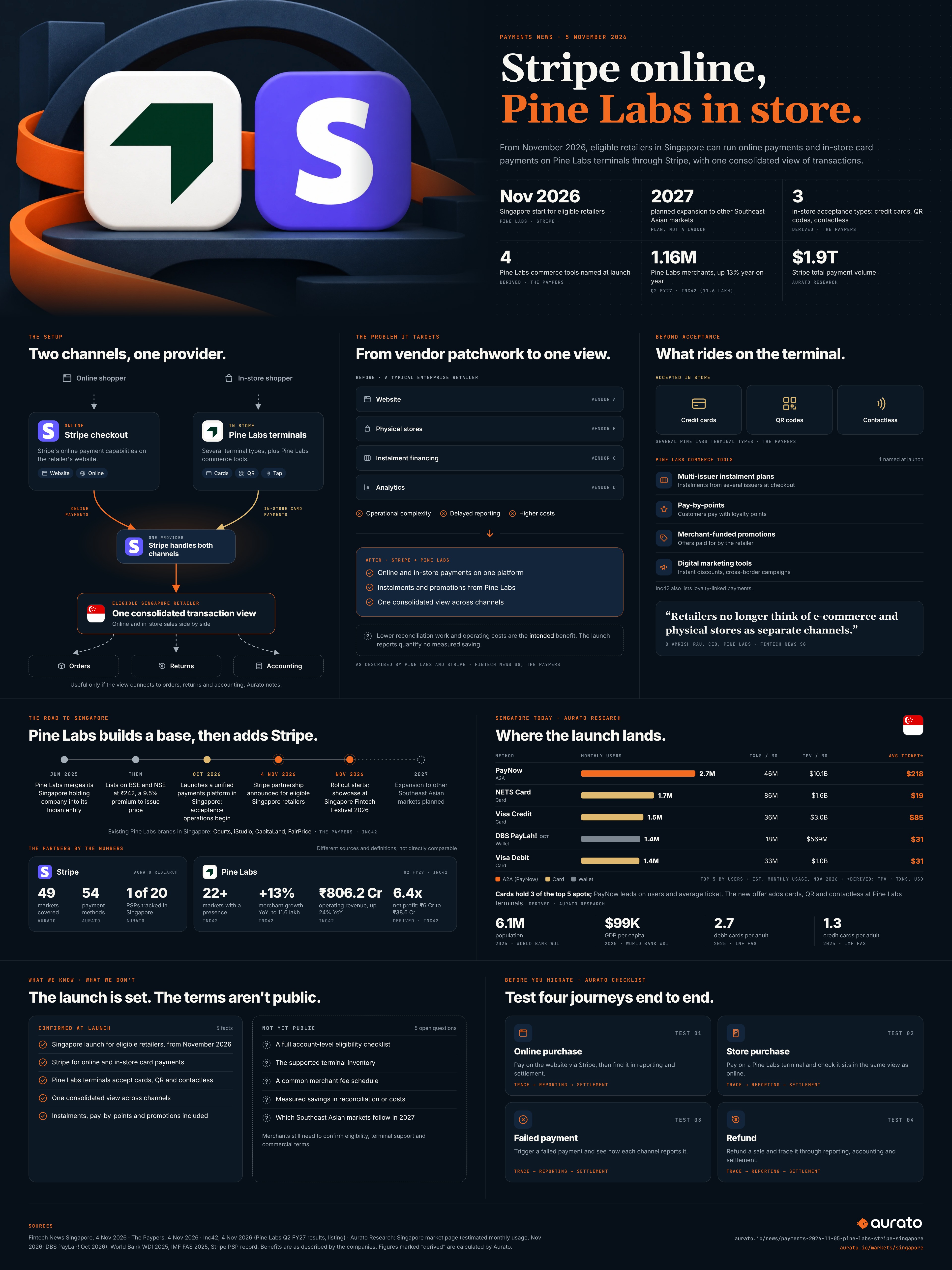
 Singapore. Starting in November 2026, participating businesses will be able to use Stripe for online payments and for in-store card payments powered by Pine Labs terminals.
The combined service gives merchants a consolidated view of transactions across online and physical channels. The partners also plan to extend the offering to other Southeast Asian markets in 2027. That is an expansion plan, rather than a confirmed launch in every country in the region.
A common view can help operations
A retailer selling through a website and physical stores needs to connect payment activity with everyday operations. A shared transaction view could make it easier to investigate a purchase or match records, especially where staff currently move between separate payment systems.
The practical benefit depends on the complete workflow. A combined dashboard is useful only if the retailer can connect transactions with its orders, returns and accounting process. Merchants should compare the proposed setup with the work their staff actually perform, rather than assuming that one platform automatically removes every manual step.
Commerce tools sit alongside acceptance
The Paypers reports that the offering includes access to Pine Labs’ commerce tools, such as instalment plans from multiple issuers, pay-by-points, merchant-funded promotions and digital marketing tools. These extend the proposition beyond simply adding a terminal to an online payment relationship.
The launch coverage describes eligible retailers and a November start, but does not provide a complete account-level eligibility checklist, supported terminal inventory or common merchant fee schedule. Claims about lower reconciliation effort and operating costs describe the intended benefit; the reports do not quantify a measured saving from this deployment.
Test the connected payment journey
Before migrating, a merchant should confirm which terminals, payment options and commerce tools are supported for its business. Testing should cover an online purchase, a store purchase, a failed payment and a refund, then trace each through reporting and settlement. That gives the retailer a concrete way to assess whether the combined service simplifies its own operations.