Infrastructure for cross-border business payments
 Airwallex is providing processing and acquiring capabilities to Boost Payment Solutions, the
 United States business-to-business payments company. Boost brings its commercial-card platform and expertise in large transactions; Airwallex supplies the infrastructure behind international acceptance.
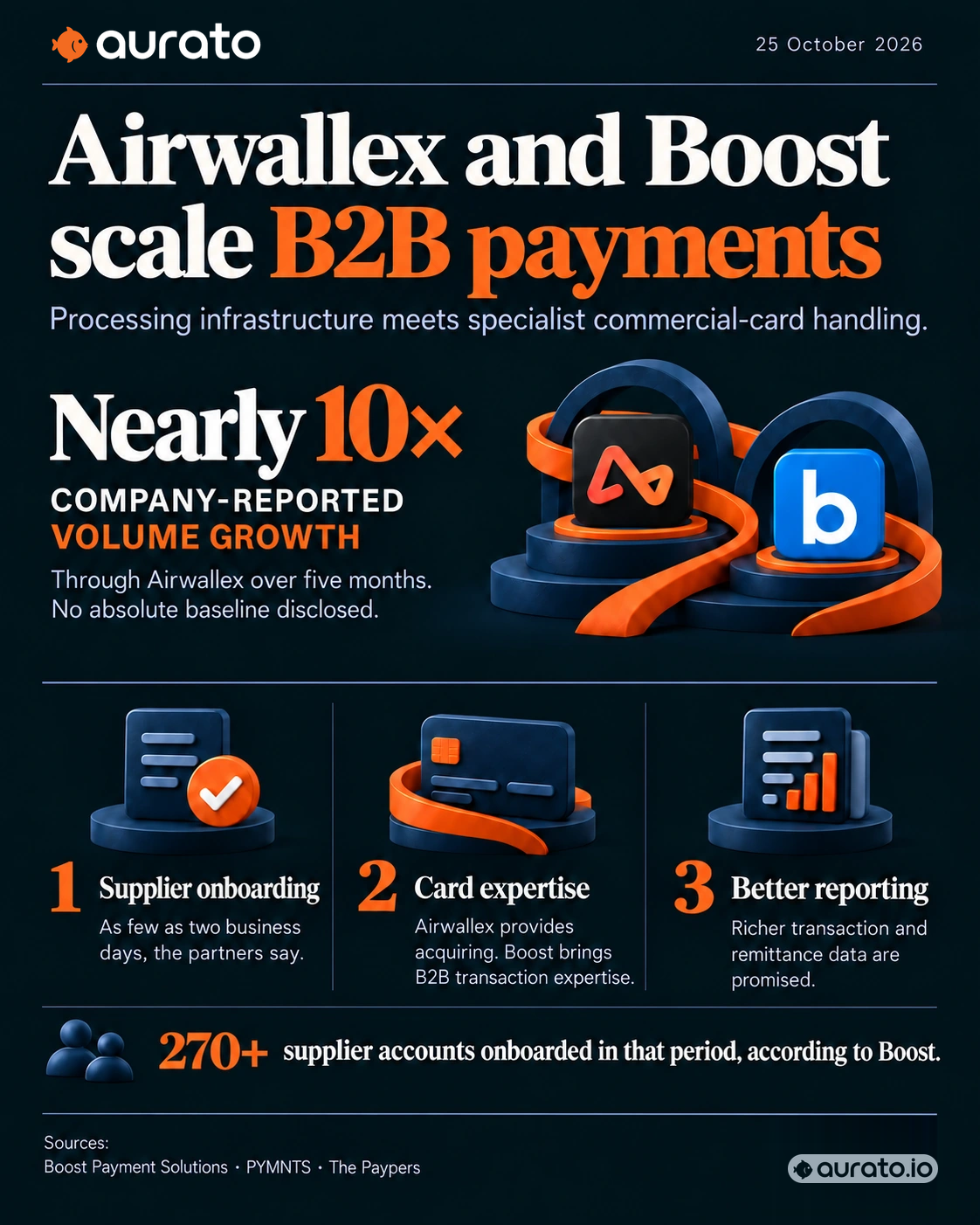
The partners say digital supplier onboarding can take as few as two business days. They also point to fewer failed or retried payments, improved settlement performance and richer transaction and remittance reporting. These are stated benefits, rather than service guarantees for every supplier.
Boost says payment volume processed through Airwallex grew nearly tenfold over five months, with more than 270 supplier accounts onboarded. The announcement describes an operating relationship that has already processed payments, alongside plans to support further market expansion.
Acceptance and data must work together
For a supplier, accepting a commercial card is only useful if the proceeds arrive predictably and can be matched to the right invoices. Bringing acquiring, onboarding and remittance information into one operating model could reduce manual work across borders.
The division of responsibilities is practical: infrastructure alone does not determine whether a business payment qualifies for a particular rate or carries the information the supplier needs. Specialist transaction handling can matter as much as the route used to move the money.
Reported growth leaves key details open
Neither the release nor the two reports provides an absolute payment-volume baseline, a complete list of live countries or a standard price schedule. Almost tenfold growth therefore describes this relationship’s expansion, not a market share or a measured improvement for every customer.
Lower processing costs depend on eligible high-value transactions qualifying for large-ticket interchange and on scheme-fee optimisation. The sources do not publish a comparable before-and-after cost study or quantified failure-rate reduction. Two-day onboarding is a best-case claim.
What businesses should check next
Buyers and suppliers should ask for the supported markets, settlement currencies, contractual entities and all-in fees for their transaction pattern. A pilot should test onboarding time, successful payments, settlement timing and invoice matching against the current process.