One acquiring relationship for online and store payments
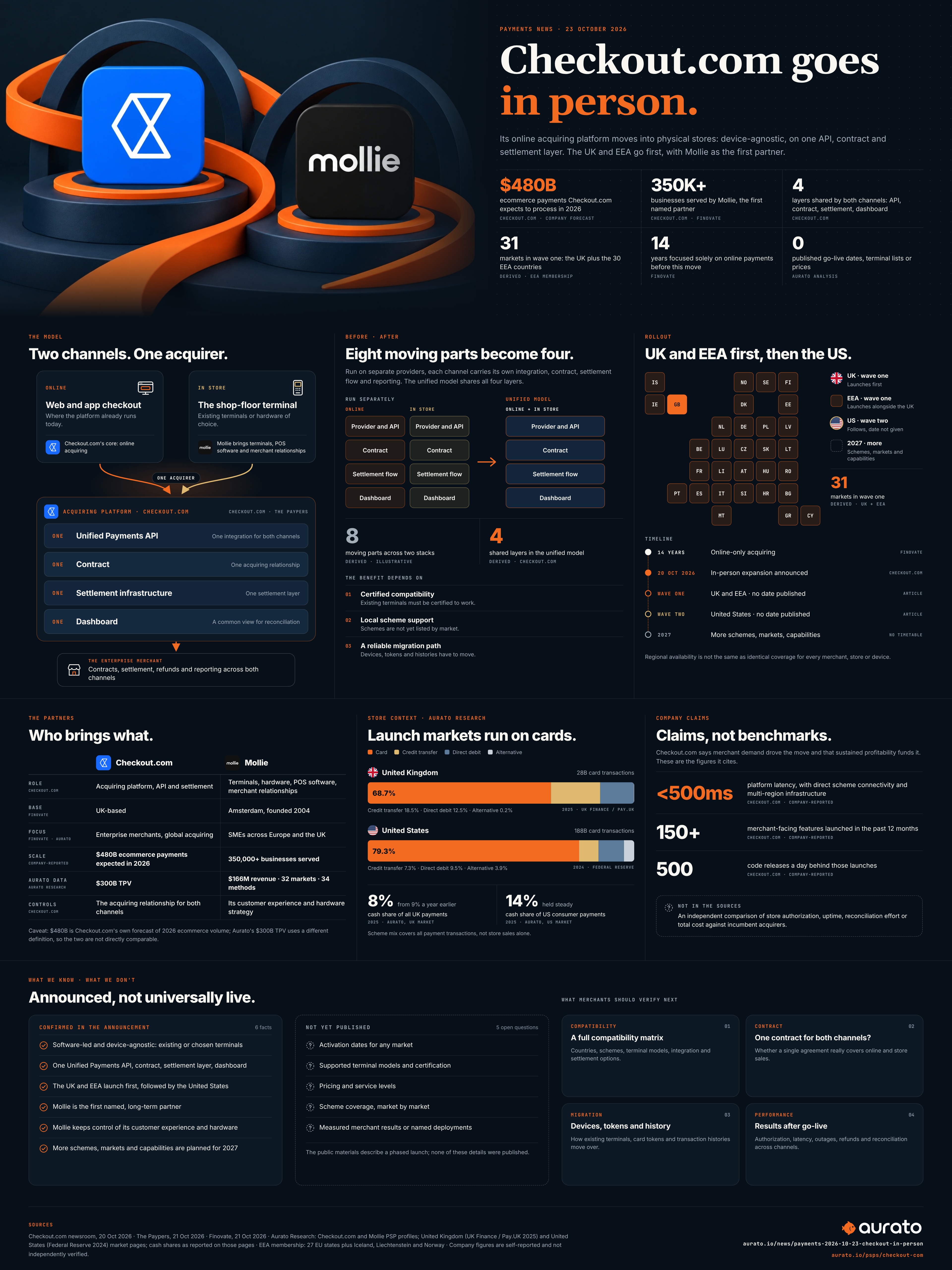
 Checkout.com is extending its acquiring platform into physical stores. Merchants may connect existing terminals or choose hardware instead of using one proprietary device. The first markets are the
 United Kingdom and European Economic Area, followed by the
 United States.
Online and store transactions are designed to share the Unified Payments API, contract, settlement infrastructure and dashboard. More schemes, markets and capabilities are planned for 2027, without a published timetable.
 Mollie is the first named partner. It brings terminal knowledge, hardware, point-of-sale software and merchant relationships; Checkout.com supplies the acquiring platform. Mollie retains control of its customer experience.
The value is a joined-up operating model
For an enterprise merchant, accepting a card is only one part of the job. Contracts, settlements, refunds and reporting must work across stores and digital sales. A common acquiring layer can reduce the systems and processes payment teams maintain.
Device choice matters for retailers that already own terminals or operate several store formats. Retaining hardware without fragmenting data and settlement could reduce change. The benefit depends on certified compatibility, local scheme support and a reliable migration path.
The rollout is announced, not universally live
The public materials describe a phased launch but omit activation dates, supported terminal models, pricing and service levels. They do not list schemes by market. Regional availability should not be read as identical coverage for every merchant, store or device.
Checkout.com says merchant demand drove the expansion and cites its scale and performance. Those are company statements. The sources provide no independent comparison of store authorisation, uptime, reconciliation effort or total cost against incumbent acquirers.
What merchants should verify next
The next useful evidence is a compatibility matrix covering countries, schemes, terminal models, integration requirements and settlement options. Merchants should ask whether one contract covers both channels and how existing devices, tokens and histories migrate.
After activation, teams should compare authorisation, latency, outage handling, refunds and reconciliation across channels. Named deployments with results would show whether the platform reduces operational complexity instead of simply placing two channels in one dashboard.