From collecting money to delivering it
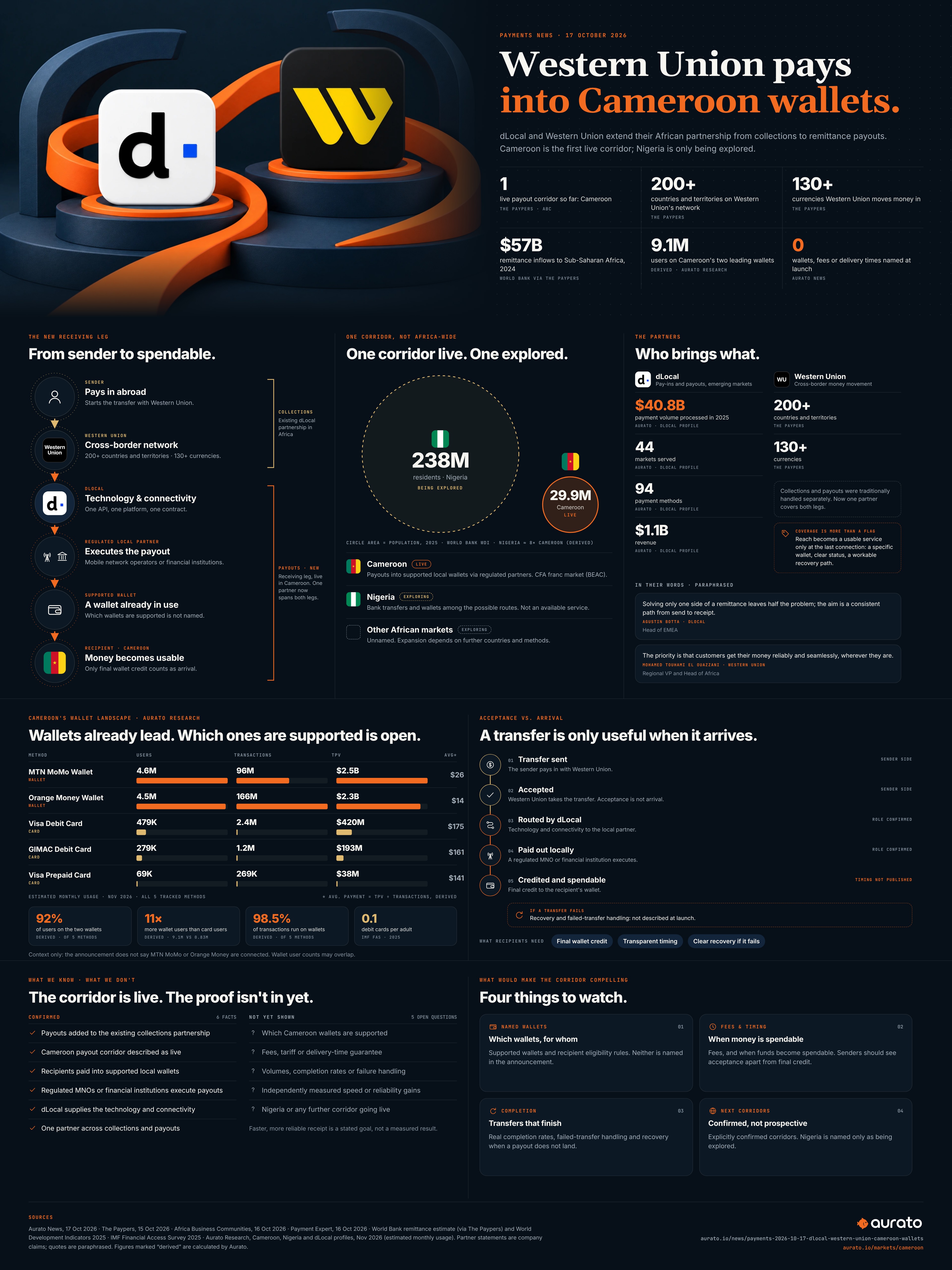
The new agreement adds the receiving leg to an existing relationship.  dLocal and Western Union already work together on African collections. The partners describe the
 Cameroon payout corridor as live, while positioning it as the starting point for an expansion.
The Paypers explains that supported wallets are reached through local payout partners, including mobile network operators or financial institutions. This is not a claim that every wallet in Cameroon is connected, nor that the new arrangement replaces those local providers.
The arrangement is intended to give Western Union one partner across collections and payouts. Payment Expert reports that Cameroon comes first, with local payout partners connecting recipients to wallets they already use; further markets remain part of the expansion plan.
A transfer is only useful when it arrives
For recipients, the important change is where money becomes usable. Receiving a transfer in a wallet already used for daily spending could remove an extra hand-off between an international remittance and a local payment account.
For a PSP, this illustrates why payout coverage is more than a country flag. The last connection—to a particular wallet, with clear transaction status and a workable recovery process—is what turns broad international reach into a usable service.
One corridor, not an Africa-wide launch
The company announcement names neither the supported Cameroon wallets nor a tariff, delivery-time guarantee or transaction-volume result. It says expansion into  Nigeria and other markets is being explored, with bank transfers and wallets among the possible routes. Those plans should not be treated as available services.
Although the partners describe faster and more reliable receipt as their goal, the coverage does not provide independently measured improvements. The launch establishes an additional payout connection, not proof of lower fees or universal instant delivery.
What would make the corridor compelling
Watch for named supported wallets, recipient eligibility rules, fees and clear explanations of when funds become spendable. A sender should be able to distinguish transfer acceptance from final credit to the recipient.
The next useful evidence would be real completion rates, failed-transfer handling and explicitly confirmed additional corridors. Expanding carefully, with dependable local delivery, would matter more than announcing a long list of prospective markets.